


 简体中文
简体中文
 English
  عربى
عربى Content
- 1 Motor Type Comparison: Application Boundaries of Different Technical Approaches
- 2 Key Parameter Analysis: How Power, Speed, and Protection Ratings Impact Purification Performance
- 3 Four Core Challenges in Industrial Environments and Response Strategies
- 4 Practical Maintenance Guide for Extending Motor Life
- 5 Selection Decision Framework: Four Steps to Lock In the Optimal Motor Solution
In the industrial air purification sector, motor technology selection directly determines equipment purification efficiency, energy consumption levels, and service life. Current industry consensus is clear: Brushless DC (BLDC) motors, with operating efficiency exceeding 85%, service life surpassing 10,000 hours, and wide-range adjustable speed capabilities, have progressively replaced traditional AC asynchronous motors as the preferred power solution for precision manufacturing and high-standard purification scenarios. In comparison, conventional AC asynchronous motors operate at approximately 70%-80% efficiency and exhibit significant shortcomings in speed regulation flexibility and noise control, making them more suitable for large industrial facilities where cost sensitivity outweighs precision requirements.
Motor Type Comparison: Application Boundaries of Different Technical Approaches
Industrial air purifier motors primarily divide into three technical routes, each displaying substantial differences in power output, efficiency, cost, and applicable scenarios. Selection must be based on a comprehensive evaluation of workshop area, pollution concentration, continuous operation duration, and budget constraints.
| Motor Type | Operating Efficiency | Service Life | Speed Range | Noise Level | Applicable Scenarios |
|---|---|---|---|---|---|
| Brushless DC Motor (BLDC) | >85% | >10,000 hours | Wide adjustable range | Low | Electronics workshops, pharmaceutical facilities |
| AC Asynchronous Motor | 70%-80% | Medium | Limited | Medium | Large factories, metallurgical workshops |
| Three-Phase Asynchronous Motor | 75%-85% | Long | Limited | Higher | Chemical plants, steel mills |
As shown in the table, BLDC motors lead comprehensively in the two core metrics of efficiency and lifespan. However, they require dedicated controllers and involve higher initial investment. AC asynchronous motors and three-phase asynchronous motors maintain advantages in structural simplicity, maintenance convenience, and high-power output, making them suitable for 24-hour continuous operation scenarios where speed regulation precision is not critical.
Key Parameter Analysis: How Power, Speed, and Protection Ratings Impact Purification Performance
Industrial air purifier motor selection cannot rely solely on experience; it must be scientifically matched based on quantitative parameters. The following four parameters directly determine equipment purification capacity and environmental adaptability.
The Matching Relationship Between Power and Air Handling Capacity
Motor power typically ranges from several hundred watts to tens of kilowatts and must be strictly matched to the purifier's fan size and air handling capacity (CADR value). For a standard 1,000-square-meter industrial workshop, effective purification requires an air handling capacity of at least 15,000 cubic meters per hour, corresponding to a motor of 7.5 kW or higher. Insufficient power can cause the motor to "stall" under high-resistance conditions, leading to winding overheating and burnout.
The Impact of Speed on Airflow Velocity
Motor speed generally falls between 1,000 and 3,000 RPM. High-speed motors are suitable for applications requiring rapid response, such as fume treatment in welding workshops, where strong suction must be generated instantly as pollution occurs. Medium-to-low-speed motors are better suited for continuous circulation purification scenarios, effectively reducing mechanical wear and energy consumption.
Protection Rating: The Hard Threshold for Industrial Environments
Industrial environments universally feature dust, humidity, or corrosive gases, requiring motor protection ratings of IP54 or higher. IP55-rated motors can withstand low-pressure water jets, while IP65-rated motors are completely dust-tight and resistant to low-pressure water spray. In chemical workshops with high concentrations of acidic or alkaline gases, motors with stainless steel housings or anti-corrosion coatings are recommended to prevent internal winding insulation degradation.
Torque: The Core Capability to Overcome System Resistance
When purifier ducting is extensive or filter clogging increases resistance, high-torque motors maintain stable rotational speed, ensuring purification efficiency does not decline. BLDC motors, through electronic commutation technology, can maintain high torque output across a wide speed range—one of their key advantages over traditional AC motors.
Four Core Challenges in Industrial Environments and Response Strategies
Industrial air purifier motors face challenges far exceeding those in residential applications, primarily manifested in environmental erosion, continuous high-load operation, vibration and noise, and voltage fluctuation. Neglecting any of these factors can cause equipment failure rates to surge.
Harsh Environmental Erosion: Dust and Corrosion Protection Combined
Once dust, oil fumes, or acidic/alkaline gases enter the motor interior, they accelerate winding insulation aging and cause abnormal bearing wear. In mechanical processing workshops where dust concentration exceeds 5 mg per cubic meter, motor surfaces and ventilation holes require cleaning at least once per month; otherwise, reduced heat dissipation efficiency will directly trigger excessive temperature rise.
Long-Term High-Load Operation: Overheat Protection Is Indispensable
Industrial production mostly involves 24-hour continuous operation, where sustained high temperatures can easily cause winding overheating and burnout. Selection must confirm that the motor includes overheat protection, overcurrent protection, and stall protection functions. When motor housing temperature exceeds 70 degrees Celsius or operating current fluctuates abnormally, immediate shutdown and inspection are required to investigate winding short circuits or bearing seizure issues.
Vibration and Noise Superposition: Dynamic Balance Is Critical
Industrial sites already have high baseline mechanical noise levels. If motor dynamic balance is poor, equipment vibration and noise will be further amplified, affecting the workshop operating environment. BLDC motors, having no brush friction, naturally generate lower mechanical noise than AC motors—a significant advantage in noise-sensitive scenarios such as precision instrument facilities.
Voltage Fluctuation: Voltage Stabilization Measures Ensure Stable Operation
In some factories, grid voltage is unstable; if fluctuation amplitude exceeds plus or minus 10%, it will cause motor speed variation, reducing purification efficiency or even burning out the motor. Voltage stabilizers are recommended for purification equipment in plants with significant voltage fluctuations, or priority should be given to BLDC control systems with wide voltage adaptation ranges.
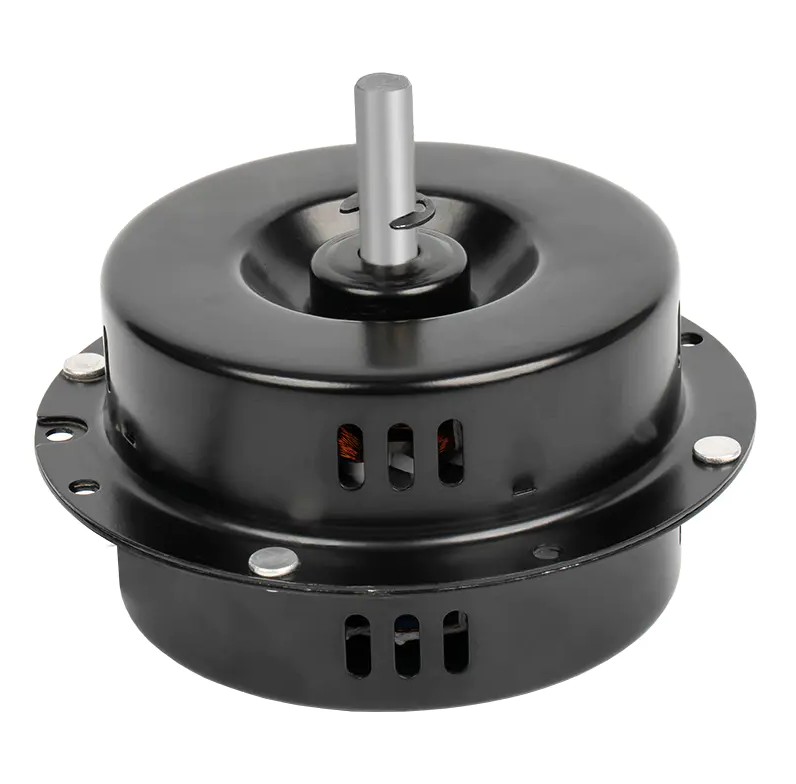
Practical Maintenance Guide for Extending Motor Life
Scientific maintenance management can extend industrial air purifier motor service life by over 30%. The following maintenance cycles and operational points have been validated across numerous industrial sites and offer clear practical value.
- Monthly cleaning: Remove dust and oil from motor surfaces, focusing on ventilation holes and fan covers to ensure unobstructed heat dissipation channels.
- Quarterly lubrication: Inspect bearing wear and replenish high-temperature grease promptly; in high-temperature workshop environments, grease degradation occurs more rapidly.
- Semi-annual testing: Use a megohmmeter to measure winding insulation resistance; insulation resistance should not be lower than 0.5 megaohms; values below this threshold require investigation of moisture or oil contamination penetration.
- Real-time monitoring: Install temperature sensors to monitor motor housing temperature; abnormal temperature rise is often a precursor signal to failure.
Furthermore, through the variable frequency speed regulation function of BLDC controllers, motor speed can be adjusted according to real-time pollution levels, avoiding unnecessary high-load operation during low-pollution periods. This strategy can save over 30% in electricity consumption during long-term operation.
Selection Decision Framework: Four Steps to Lock In the Optimal Motor Solution
Facing diverse motor products, establishing a systematic selection logic is key to avoiding resource waste. The following four-step framework helps procurement and engineering personnel rapidly identify the optimal solution.
- Match purification requirements: Calculate required air handling capacity based on workshop area and pollution concentration, then derive motor power and speed. For example, welding workshops with high fume concentration require high-speed, high-torque motors; general ventilation scenarios can use reduced speed to extend service life.
- Evaluate environmental adaptability: High-dust environments prioritize motors with good sealing and dust covers; humid or corrosive environments require stainless steel housings or anti-corrosion coatings.
- Balance energy efficiency and cost: BLDC motors involve higher initial investment but deliver significant long-term energy savings, suitable for continuous operation scenarios; where budget is limited or usage is short-term, AC asynchronous motors remain a pragmatic choice.
- Confirm protection functions and after-sales support: Prioritize motors with triple protection (overheat, overcurrent, and stall), and confirm that the supplier can provide rapid-response after-sales support to minimize production downtime impact.
Synthesizing the above analysis, the core of industrial air purifier motor selection lies in "scenario adaptation" rather than "parameter stacking". Only by integrating purification requirements, environmental conditions, operating costs, and maintenance capabilities into a unified decision model can the optimal balance between purification efficiency and equipment lifespan be achieved.


 Home
Home  Tel.: +86-13819807486
 Whatsapp:+86 13819807486
 E-mail:


